


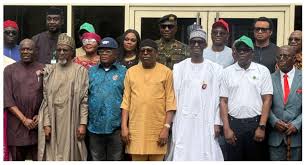
A high-level federal delegation arrived in Rivers State on Monday, December 22, 2025, for meetings and inspections with Governor Siminalayi Fubara in Port Harcourt as part of efforts to address long standing development and environmental issues in the region. The visiting officials held discussions with the governor before proceeding to key project sites around the state.
Leading the delegation was the National Security Adviser (NSA), Nuhu Ribadu, who travelled with other top government figures. Alongside him were the Minister of Works, Engineer David Umahi, the Minister of Environment, Balarabe Lawal, and the Director-General of the National Oil Spill Detection and Response Agency (NOSDRA), Chukwuemeka Woke. Their presence signalled federal interest in strengthening cooperation with Rivers State on issues that affect security, infrastructure, and the environment.
The group was welcomed at the Port Harcourt International Airport by members of the Ogoni Mothers Union and other community stakeholders. In remarks after the meeting at the Government House, Governor Fubara thanked the team for coming and stressed the importance of working together on priorities that matter to residents.
Following the initial discussions, the delegation planned a series of field visits in Ogoniland and beyond. One of the first stops was set to be the East-West Road, a major transportation route crucial for economic activities in the Niger Delta. This road has long been considered a priority for repair and completion, given its impact on trade and mobility.
Another focus of the visit was environmental remediation. Officials were scheduled to inspect the Yorla Oilfield spill site at Kpean Community, where oil pollution has damaged farmland, water sources, and local livelihoods. Addressing these environmental problems has been a long-standing demand of local communities in Ogoniland.
The federal team also planned to visit institutions that play key roles in community development, including the University of Environmental Technology in Ogoni, the Gokana Oil Facility and Hospital in K-Dere, the Industrial Park site, and Taabaa General Hospital. These visits reflect an integrated approach combining environmental action with healthcare, education, and economic growth.
A significant part of the itinerary was a scheduled meeting with the Ogoni Dialogue Committee, an influential body representing the interests of communities affected by oil pollution and underdevelopment. The meeting aimed to deepen understanding of local concerns and foster collaboration on solutions that address environmental contamination, job creation, and infrastructure gaps.
Political observers said the visit underscored renewed federal-state engagement after months of political uncertainty in Rivers State. Governor Fubara, whose administration has emphasised development and stability, welcomed the delegation’s involvement as a boost for ongoing projects and plans.
Residents and stakeholders are now watching closely to see if the interactions and inspections translate into concrete outcomes especially in areas that have long suffered from neglect, pollution, and poor infrastructure. The success of the visit may help shape future partnerships between Rivers State and federal agencies for sustainable growth and environmental restoration.